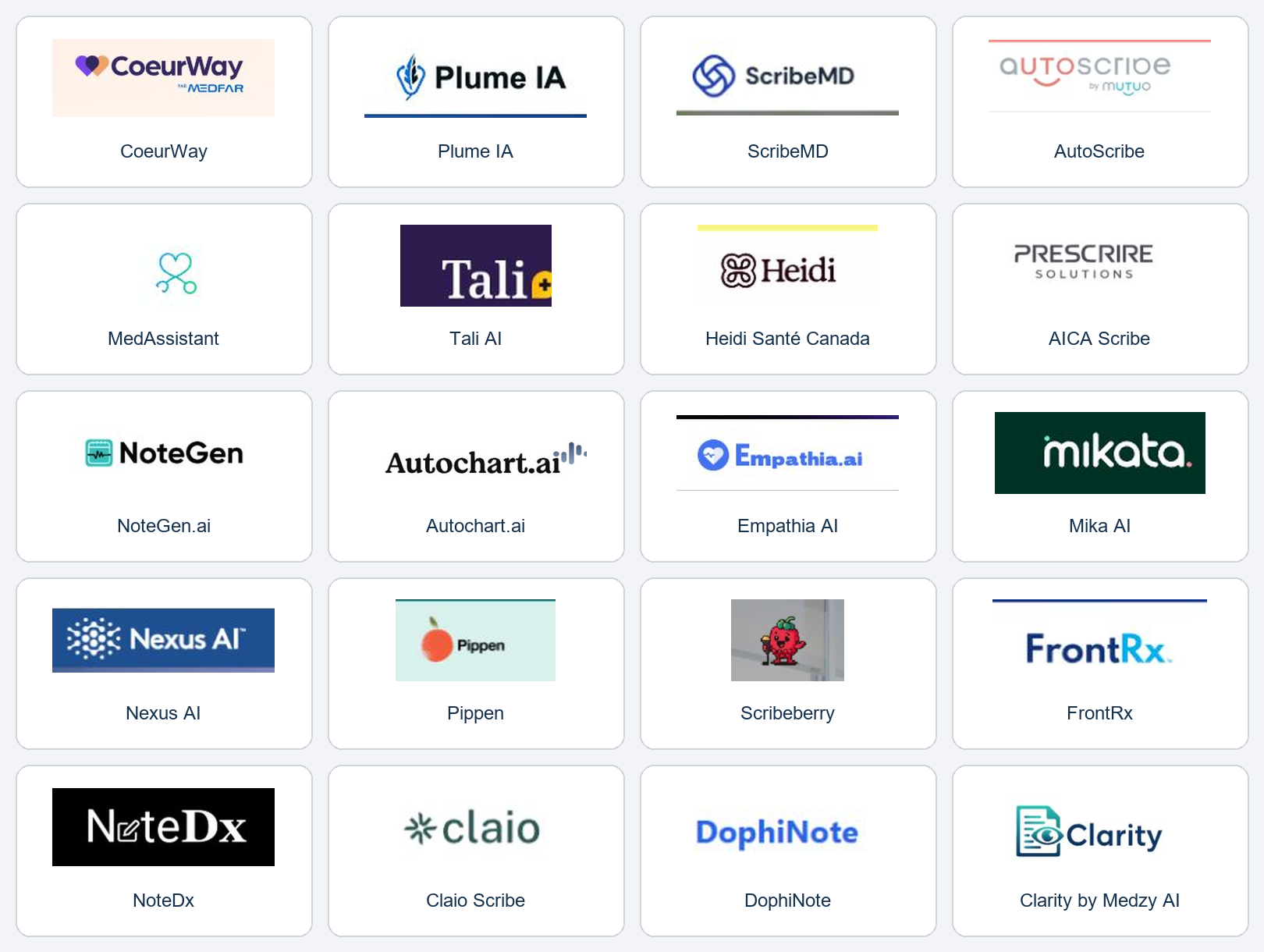
Teché’s current Quebec AI-scribe research set contains 20 products. That number sounds useful until a clinic has to choose one.
A market map can show what exists. It can separate current official status from provider claims, identify products with an explicit Quebec connection and expose questions that remain unanswered. It cannot decide whether a product fits the way a particular clinic documents care, reviews notes, transfers information to the DME or responds when the system fails.
That is the reason we built the Quebec AI Scribe Landscape 2026 as research, not as a ranking.
A longer list does not create a better shortlist
AI scribes are often presented as if they solve one problem in one way. They do not. The market includes focused documentation tools, broader clinical workflow platforms, products built around primary care and adjacent tools that automate parts of document creation.
The same product can reduce friction in one clinic and create new review work in another. The difference is usually not the demonstration. It is the operating context around the product.
What public evidence can establish
Public sources can help a clinic verify the exact provider, product, dated status, stated capabilities and published privacy or security information. They can also show where the evidence stops.
For Quebec clinics, TGV status and an EFVP do not answer the same question. A public status does not remove the acquiring organization’s responsibility to assess its own context, proposed configuration, data flows, risks and professional obligations. The Teché TGV and EFVP explainer separates those layers in plain language.
Five questions that turn research into a clinic decision
- Which workflow are we trying to improve? Name the visit types, documentation steps, roles, delays and handoffs before comparing products.
- What exact product and version are being proposed? Match every status, claim, integration and contract term to that proposal.
- What work remains with the clinic? Include consent, review, correction, DME transfer, exception handling, support and downtime.
- What evidence is still missing? Treat an unanswered question as an open item with an owner and deadline, not as an assumed yes.
- What would make the clinic expand, change or stop? Define measures and stop rules before the first live pilot.
Navigator, Research and Consulting have different jobs
The HealthTech Navigator helps clinics discover the market. Teché Research organizes and labels the evidence. Consulting starts when a clinic needs to determine fit for its own workflow, risks and team.
That separation matters. A product can be relevant enough to document without being the right product for a specific clinic. A visible profile is not a recommendation, and no vendor can pay Teché to become the answer to a consulting decision.
Start with the market, then come back to the workflow
Read the 20-product landscape, review the dated sources and keep a record of the questions that still need proof. If several options remain plausible, the Clinical Operations Assessment maps the real workflow and requirements before a selection or pilot.
Reviewed and published by Uzziel Tamon. Evidence reviewed August 29, 2026. This article is practical information and does not replace legal, privacy, security or professional advice.